Choosing a Chemical Metering Pump: What type of pump is best for your application?
Accurate chemical dosing is critical across water treatment, oil and gas, food and beverage, pharmaceutical, and industrial processing. Chemical metering pumps deliver precise, controlled flow rates, often against variable pressures and strict repeatability requirements. Choosing the right pump technology means understanding each type’s operating principles, advantages, and limitations. This overview covers four common metering pump types: diaphragm, peristaltic, piston/plunger, and solenoid-driven.
Diaphragm Metering Pumps
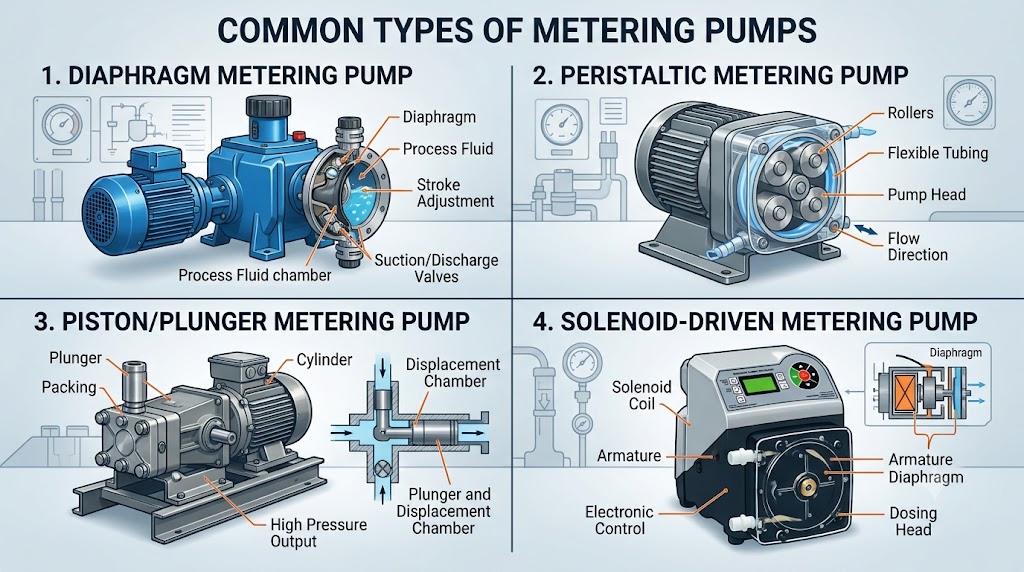
Diaphragm metering pumps are among the most common technologies for chemical dosing. They use a flexible diaphragm, often made of PTFE or EPDM, to create reciprocating motion in a sealed chamber. The diaphragm is actuated mechanically, through a cam or eccentric mechanism, or hydraulically, using an oil-filled backing chamber.
A key advantage is that the process fluid never touches moving parts like seals or bearings. The diaphragm fully separates the fluid from the drive mechanism. This eliminates leakage risk along a rotating shaft and suits diaphragm pumps to aggressive or hazardous chemicals. Some manufacturers offer dual-diaphragm designs, which protect the dry side if the primary diaphragm fails. Hydraulically actuated diaphragm pumps offer strong pressure capability and dosing accuracy. Turndown ratios can exceed 100:1 with variable-speed drives or stroke adjustment.
Diaphragm pumps do have limitations. Diaphragm fatigue and eventual failure are ongoing wear concerns. Check valve fouling can also affect accuracy when dosing fluids with suspended solids. When choosing a diaphragm pump, confirm the manufacturer can supply replacement diaphragms and common parts.
Peristaltic Metering Pumps
Peristaltic, or hose/tube pumps, operate by compressing a flexible tube using rotating rollers or shoes, forcing fluid through the tube in discrete, mechanically induced pulses. Because the fluid is contained entirely within the tubing, peristaltic pumps offer strong resistance to fouling from abrasive or viscous media and require no check valves, making them advantageous for slurries or chemicals prone to crystallization. Maintenance is generally limited to periodic tube replacement, simplifying servicing. However, tube life is finite and pressure capability is typically lower than diaphragm alternatives, which can constrain use in higher-pressure injection points.
Piston/Plunger Metering Pumps
Peristaltic, or hose/tube pumps, compress a flexible tube using rotating rollers or shoes. This forces fluid through the tube in discrete pulses. Because fluid stays entirely within the tubing, these pumps resist fouling well. They handle abrasive or viscous media without needing check valves. This makes them useful for slurries or crystallizing chemicals. Maintenance is generally limited to periodic tube replacement, which simplifies servicing. However, tube life is finite, and pressure capability is typically lower than diaphragm pumps. This can limit their use at higher-pressure injection points.
Solenoid-Driven Metering Pumps
Solenoid-driven pumps use an electromagnetic solenoid to actuate a diaphragm or piston. They move in short, rapid, electronically controlled strokes. These pumps are compact, cost-effective, and well suited to lower-flow applications. They’re common in water treatment dosing. Digital control of stroke frequency allows precise, adjustable output. However, overall flow capacity is generally more limited than mechanically or hydraulically driven pumps.
Conclusion
Each metering pump technology involves tradeoffs among chemical compatibility, pressure capability, accuracy, and maintenance. Diaphragm pumps remain a preferred choice for demanding, corrosive-chemical applications. Peristaltic, piston/plunger, and solenoid-driven pumps each address specific process needs. A thorough evaluation of flow rate, pressure, fluid characteristics, and turndown is essential. This helps identify the optimal technology for a given metering application. When selecting a manufacturer, consider expected pump service life. Also check parts availability and how responsive the manufacturer or rep is if problems arise.