Choosing the Best Chemical Metering Pump: Simplex, Duplex, Triplex, or Multiplex
Chemical metering pumps are a critical, if often overlooked, part of many industrial processes — from water treatment and oil and gas to food and beverage production. Getting the right configuration isn’t just a technical detail; it directly affects dosing accuracy, uptime, maintenance costs, and total cost of ownership. For procurement teams evaluating vendors and quotes, understanding the difference between simplex, duplex, triplex, and multiplex pump configurations can help you ask the right questions and avoid costly mismatches.
What “Simplex,” “Duplex,” “Triplex,” and “Multiplex” Mean
These terms refer to the number of pumping heads (or “plungers”/diaphragms) built into a single pump unit:
- Simplex — one pumping head
- Duplex — two pumping heads
- Triplex — three pumping heads
- Multiplex — four or more pumping heads
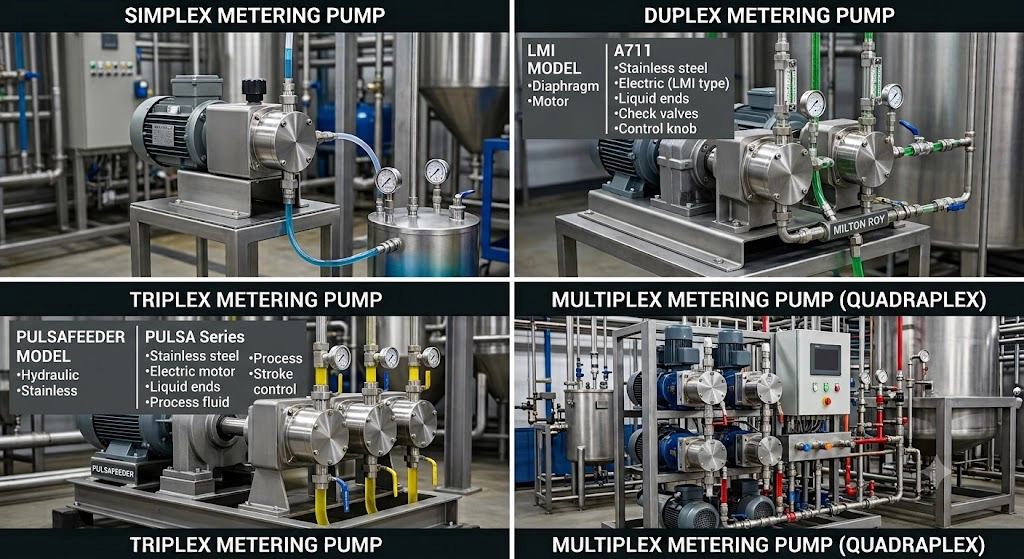
Each additional head changes how the pump delivers flow, how it handles downtime, and how much it costs upfront and over its lifecycle.
Simplex Pumps: Simple, Affordable, Widely Used
Simplex pumps are the standard choice for straightforward, single-chemical dosing applications. Their key advantages:
- Lower upfront cost — fewer moving parts means a smaller capital investment
- Simple maintenance — one head to service, straightforward troubleshooting
- Smaller footprint — ideal for space-constrained installations
The trade-off is pulsating flow (less smooth than multi-head designs) and no built-in redundancy — if the pump goes down, dosing stops entirely.
Duplex Pumps: Redundancy and Dosing Multiple Chemicals
Duplex pumps add a second head, which opens up two common configurations: two heads running in parallel for redundancy, or two heads offset to smooth out flow pulsation. Advantages include:
- Built-in redundancy — one head can continue dosing (or serve as backup) if the other requires service, reducing unplanned downtime
- Smoother output — staggered strokes reduce pulsation compared to simplex
- Flexibility — can dose two different chemicals simultaneously from one unit, or double capacity for a single chemical
The added complexity means a higher price point and more parts to maintain than simplex, but for processes where downtime is costly, that trade-off often pays for itself quickly.
Triplex Pumps: Higher Capacity, Steadier Flow, Dosing Multiple Chemicals
Triplex pumps use three heads, typically phased 120 degrees apart. This configuration is popular in higher-volume or higher-pressure applications. Advantages:
- Very smooth, near-continuous flow — the three-head phasing significantly reduces pulsation compared to simplex or duplex
- Higher throughput — suited to larger-scale dosing needs without oversizing a single head
- Better pressure stability — beneficial for processes sensitive to flow variation
- Partial redundancy — the unit can often continue operating at reduced capacity if one head needs servicing
Triplex pumps generally cost more than duplex units and require more sophisticated maintenance planning, but they’re a common sweet spot for mid-to-large industrial operations.
Multiplex Pumps: Built for Scale and Complexity
Multiplex configurations (four or more heads) are used where a facility needs to dose multiple chemicals simultaneously, handle very high volumes, or maximize redundancy across a critical process. Advantages:
- Maximum flexibility — can dose several different chemicals independently from a single frame
- High redundancy — multiple heads mean the system can tolerate several simultaneous maintenance events or failures without full shutdown
- Consolidated footprint — one multiplex unit can replace several standalone pumps, simplifying installation and controls integration
- Smooth, high-volume output — ideal for continuous, large-scale processes
Multiplex pumps carry the highest upfront cost and the most complex maintenance requirements, so they’re typically reserved for large facilities or processes where consolidating multiple dosing points into one system offers a clear operational payoff.
Make the Best Choice
When comparing quotes, it’s worth looking beyond the sticker price to:
- Total cost of ownership — maintenance frequency, spare parts, and expected downtime costs
- Redundancy needs — how costly is unplanned downtime in your process?
- Flow smoothness requirements — some processes tolerate pulsation; others don’t
- Future scalability — will chemical dosing needs grow, and does the configuration allow for expansion?
Simplex pumps remain the most cost-effective choice for simple, single-chemical applications with tolerant flow requirements. Duplex and triplex configurations are worth the added investment when downtime risk or flow smoothness matters. Multiplex systems make the most sense for large or complex facilities consolidating multiple dosing needs into one system. Matching the configuration to your actual operating requirements — rather than defaulting to the cheapest or most feature-rich option — is the key to getting long-term value from the investment.