When engineers and procurement teams shop for a metering pump, flow rate accuracy, pressure rating, and price tend to dominate the conversation. Chemical resistance often gets treated as an afterthought, a box to check rather than a criterion to weigh carefully. That’s a mistake. Of all the specifications on a metering pump datasheet, compatibility between the wetted materials and the process fluid may be the single factor most likely to determine whether a pump lasts for years or fails within weeks.
What “Chemical Resistance” Actually Means
Every metering pump has wetted parts that come into direct contact with the fluid being dosed. This includes the diaphragm or piston, seals, O-rings, valve balls, valve seats, and the pump head itself. Chemical resistance describes how well those materials hold up against degradation from that fluid over time, under real operating conditions of temperature, concentration, and pressure. Manufacturers typically offer a range of material options: PVC, PVDF, polypropylene, and stainless steel for pump heads; PTFE, EPDM, Viton, or Hypalon for seals and diaphragms. Choosing correctly among these options is not a minor customization. It’s central to the pump’s viability for a given application.
The Cost of Getting It Wrong
A mismatch between chemical and wetted material rarely fails gracefully. Instead of a slow, predictable decline, incompatible materials tend to degrade through swelling, cracking, embrittlement, or outright dissolution. A diaphragm that swells slightly can throw off dosing accuracy long before it ruptures. A seal that becomes brittle in the presence of a strong oxidizer can fail suddenly, releasing chemical into the surrounding environment. In industries handling corrosive or hazardous fluids this isn’t just a maintenance inconvenience. It’s a safety incident waiting to happen.
Beyond the safety dimension, the financial cost compounds quickly. Unplanned pump failures mean production downtime, emergency part replacement, and potentially contaminated batches if the dosed chemical was part of a controlled process. Frequent seal or diaphragm replacement due to poor compatibility also erodes the total cost of ownership advantage that metering pumps are supposed to offer over cruder dosing methods.
Concentration, Temperature, and Time Matter Too
Chemical resistance isn’t a simple yes or no property. A material that resists a chemical at room temperature and moderate concentration may fail when temperature rises or concentration increases. Sulfuric acid at 10% concentration behaves very differently toward a given polymer than sulfuric acid at 90% concentration. Similarly, resistance ratings are typically built on exposure over a defined time period. A material can appear stable in short-term testing while still degrading gradually over months of continuous service. Anyone selecting a pump should look at manufacturer compatibility charts with these variables in mind, not just a single pass or fail rating. They should also account for the specific temperature and concentration range the pump will actually see in service, not idealized lab conditions.
Mixed and Changing Chemistries
Many real-world processes don’t involve a single, stable fluid. Wastewater treatment plants deal with fluctuating pH and contaminant loads. Manufacturing processes may switch between cleaning chemicals and process chemicals using the same pump. In these cases, chemical resistance needs to be evaluated against the full range of fluids the pump might encounter, not just the primary one. This is where consulting with pump manufacturers or material compatibility databases pays off. Guessing based on a single chemical’s Safety Data Sheet can miss important edge cases.
Building Chemical Resistance Into the Selection Process
Rather than treating chemical resistance as a final check, it deserves a seat at the table alongside flow rate and pressure requirements from the start. That means documenting every fluid the pump will contact, its full concentration and temperature range, and any likely future chemistries before requesting quotes. It also means resisting the temptation to default to a “universal” material choice for the sake of simplicity. What works broadly often works optimally for nothing.
The Bottom Line
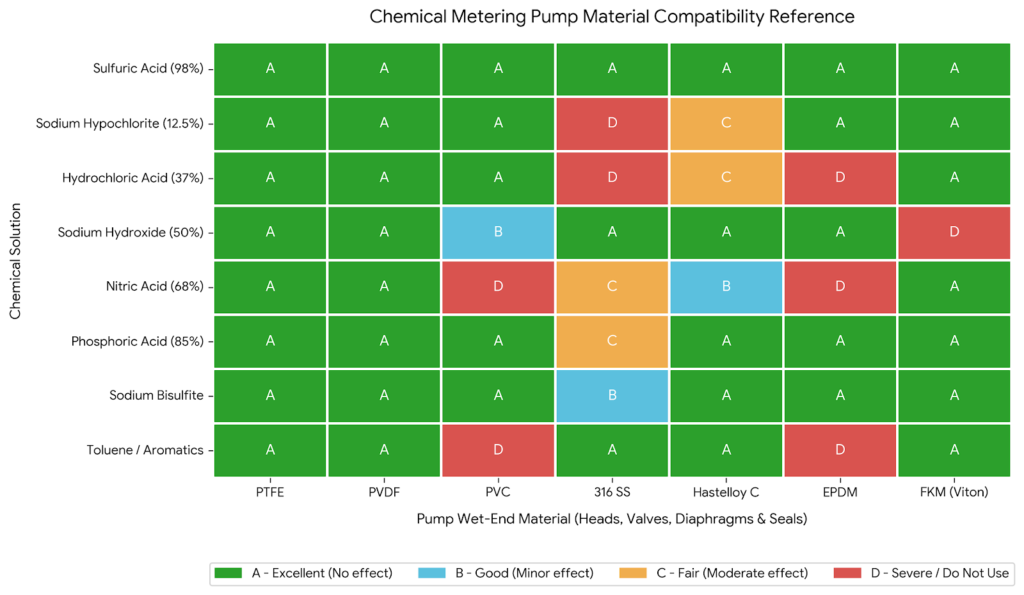
A metering pump is only as reliable as its weakest wetted component. Precision electronics and well-engineered mechanics can’t compensate for a diaphragm that dissolves or a seal that cracks under chemical attack. Prioritizing chemical resistance during selection isn’t an extra step. It’s the foundation that determines whether every other spec on the pump actually holds up in practice. The chemical resistance chart below shows common materials used for the wetted-end of pumps and chemicals that are often used.